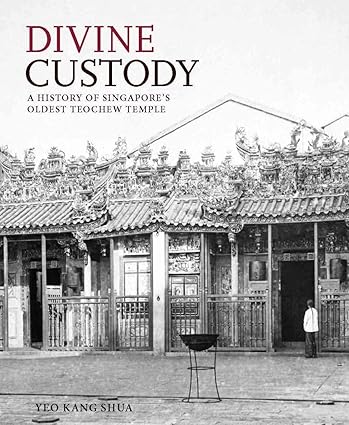
Divine Custody: A History of Singapore's Oldest Teochew Temple
Divine Custody: A History of Singapore's Oldest Teochew Temple
无法加载取货服务可用情况
Publisher: NUS Press
ISBN/EAN: 9789813251441
Publication Date: 2021/11/30
Number of Pages: 288
Size:
Language: English
Synopsis
Teochew-speaking gambier and pepper farmers were early settlers of Singapore at the turn of the 19th century. Wak Hai Cheng Bio, now surrounded by the skyscrapers of Singapore's central business district, traces its history back to the earliest days of the colony. Its two deities - the Emperor of Heaven and Mazu, the Goddess of the Seas, tutelary deities of the Teochew people and travellers by sea respectively, long accompanied the sojourns of Teochew-speakers in the region. No written sources or inscriptions commemorate the founding of the temple, but the author's research in the history of land tenure of Singapore and old maps and title deeds provide new evidence for the temple's foundation.
Just as eloquent as these forms of textual evidence, and the many poetic and commemorative inscriptions that enliven the temple and charge its spaces with meaning, is the testimony of the building itself, its siting, materials, its ornamentation and artworks. The author led the UNESCO award-winning effort to restore the temple from 2010 to 2014, and so is uniquely placed to understand what its architecture can tell us of the legacies and histories of the communities that formed and were formed by the temple. The book is exemplary in the way it uses material culture and architectural history as historical sources, and so will be of interest to heritage studies, history and those seeking to understand the experience of Chinese communities in Southeast Asia.
Published with the support of the National Heritage Board.
About The Author
Content
Title Page, Copyright
Contents
Note on Translation, Transliteration and Traditional Chinese Script
Acknowledgements
Introduction
1. History of the Temple's Property and Origins
2. Changing Social Relationships with the Temple across the Centuries
3. Architectural Developments in the 19th and 20th Centuries
4. The 2010 to 2014 Restoration
5. Conclusion
6. Bibliographical Appreciation
Endnotes
Appendix
List of Figures
Bibliography
Index
Share